
Healthcare is changing fast. Faster than most people expected.
And right at the centre of that change is artificial intelligence.
But here’s the real question you might be asking. Is AI making healthcare more efficient at the cost of human connection, or is it finally helping bring that connection back?
The answer is clearer than you might think.
AI is not replacing doctors. It is helping them. It is not removing the human side of care. It is creating space for it.
From my perspective, and from what we now see across healthcare systems globally, AI in healthcare is doing something powerful. It is helping organise complex health data, reduce unnecessary admin work, and improve how patients and doctors communicate with each other.
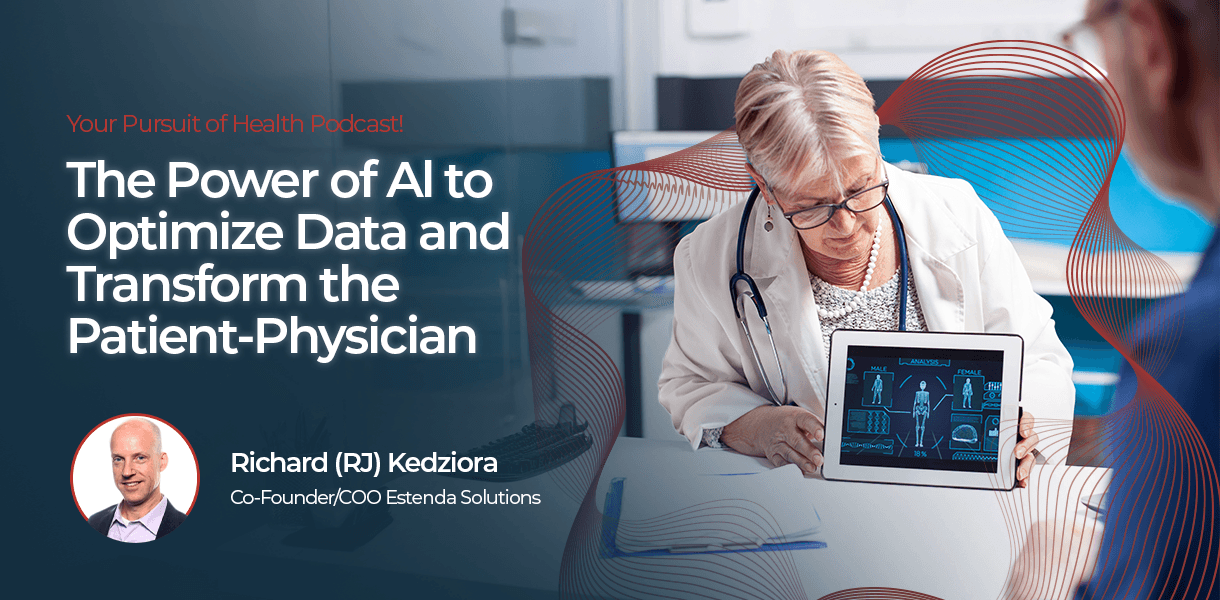
I recently had the opportunity to explore this topic further after being featured in Episode 86 of The Pursuit of Health Podcast, titled “The Power of AI to Optimize Data and Transform the Patient-Physician Partnership.” That conversation reinforced something important. The real impact of AI is not just technical. It is deeply human.
And that matters. Because good healthcare is not just data. It is trust. It is understanding. It is a partnership.
In this article, you will see exactly how AI optimises healthcare data and strengthens the patient-physician relationship. Not in theory, but in real, practical ways that are already happening today.
AI Adoption in Healthcare Is Accelerating Rapidly
According to a 2026 survey from the American Medical Association (AMA), 81% of physicians now use AI in their practices, more than doubling from 38% in 2023.
This rapid increase signals a major shift.
Earlier concerns suggested that clinicians might resist AI or that it could negatively impact care quality. However, real-world adoption tells a different story. Physicians are not only using AI, they are finding tangible value in it.
As AMA CEO Dr. John Whyte explains:
“AI has quickly become part of everyday medical practice. Physicians see real promise in its ability to support clinical decisions and cut down on administrative burden. But as this technology advances, it is critical that augmented intelligence be designed to enhance — not replace — physicians.”
This reinforces a key theme across modern healthcare technology.
AI is not replacing clinicians. It is augmenting clinical expertise.
How AI Optimizes Data and Enhances the Patient-Physician Partnership
AI optimizes healthcare data by making it structured, accessible, and actionable across the care journey. It enhances the patient-physician partnership by improving communication, enabling shared decision-making, and supporting more personalized care.
For organizations across MedTech, digital health, and life sciences, this is already shaping how solutions are designed, validated, and deployed.
Reducing Administrative Burden to Strengthen the Patient-Physician Relationship
AI reduces administrative burden by automating documentation, clinical note generation, and routine workflows. This frees up clinicians to focus on patient interaction.
This is one of the most immediate and measurable impacts of AI in healthcare.
For years, digital systems have increased the administrative load on clinicians. Electronic medical records introduced structure, but also friction.
RJ captures this perfectly:
“You didn't get into this to click boxes and check things and stare at a computer screen.”
For MedTech and digital health innovators, this is a clear opportunity. Solutions that reduce clinician workload are not just operational improvements. They directly influence patient experience.
Ambient listening, AI-assisted documentation, and automated communication tools are already reshaping workflows. These technologies capture clinical conversations, generate structured notes, and reduce manual data entry.
RJ explains the outcome clearly:
“The AI systems that we're starting to implement… allow doctors… to return to what they wanted to do in medicine, which is help people.”
That shift is critical.
When clinicians are less focused on systems and more focused on patients, trust improves. Engagement improves. Outcomes improve.
For organizations building healthcare technology, reducing administrative burden is not just a feature. It is a strategic advantage.
Transforming Healthcare Data into Actionable Clinical Insights
AI transforms fragmented healthcare data into insights that support diagnosis, treatment, and care planning.
Healthcare systems already generate massive volumes of data. Clinical records, lab results, imaging, wearable data, and research publications continue to grow.
The challenge is not data collection. It is data utilization.
RJ highlights this clearly:
“We have the data that we have, and it's a powerful set of information that's been gathered together over decades now.”
However, clinicians cannot manually process all available information in real time.
“We can't keep up with the knowledge as you're working with a patient.”
This is where AI creates real value.
AI systems can integrate multiple data sources, analyze patterns, and surface relevant insights during clinical workflows. They can also incorporate the latest research and suggest areas for further investigation.
“AI… can surface the current research data, can generate questions to ask and try and get to the root causes.”
For life sciences and MedTech organizations, this capability is essential.
It supports evidence-based care. It enhances clinical decision support systems. It improves the value of digital therapeutics and connected health platforms.
More importantly, it ensures that data is not just collected. It is used effectively.
Empowering Patients Through Better Access to Health Information
AI empowers patients by making complex health information understandable, accessible, and actionable.
This represents a shift in healthcare dynamics. Patients are no longer passive recipients of care. They are informed participants.
RJ points out a critical starting point:
“You as an individual have rights to your data. A lot of people don't realize that, but you do.”
Access to data alone is not enough. Patients need tools to interpret that data.
AI-driven interfaces can translate clinical language into plain language. They allow patients to explore their conditions, understand treatment options, and prepare for consultations.
“I can actually go and be like, can you explain this to me like I'm five years old?”
This flexibility changes engagement.
Patients can learn at their own pace. They can ask better questions. They can participate more actively in decisions about their care.
“I, as an individual, a patient, can do the same thing… what are some questions that I need to ask them?”
And as RJ explains:
“It's that opportunity to engage when the individual is ready to engage at the level they're comfortable.”
For digital health and patient engagement platforms, this is a key design principle.
Solutions must not only provide data. They must enable understanding.
Because informed patients lead to better adherence, better outcomes, and stronger partnerships with clinicians.
Expanding Care Beyond the Clinic with Digital Health and Wearables
AI extends healthcare beyond traditional clinical settings by integrating data from wearables, mobile applications, and remote monitoring tools.
This is a major shift in how care is delivered.
Healthcare is no longer limited to episodic visits. It is becoming continuous, data-driven, and personalized.
RJ summarizes this shift clearly:
“So much of my health happens outside of the four walls of a doctor's office or a hospital.”
Wearable devices and digital health platforms generate real-time data on activity, sleep, heart rate, glucose levels, and more.
AI analyzes this data to provide insights that support behavior change and early intervention.
RJ shares a simple but powerful example:
“You can see the difference in your blood glucose… just go for a walk after, and it makes a noticeable difference. It's a powerful teaching moment for individuals.”
For MedTech and life sciences organizations, this opens new opportunities.
Remote monitoring enables proactive care. Digital therapeutics support behavior change. AI-driven analytics turn continuous data streams into meaningful insights.
Accessibility is another critical factor.
“These digital health applications can level that playing field… make these things more accessible.”
This is particularly important in underserved populations and regions with limited access to care.
Scalable digital solutions can bridge gaps and extend care to more people.
Enhancing Clinical Decision-Making with AI-Driven Data Integration
AI enhances clinical decision-making by integrating diverse data sources and supporting evidence-based recommendations.
However, the role of AI is not to replace clinicians. It is to support them.
RJ provides a clear and effective framing:
“AI is artificial intelligence, but I think of it very much as augmented intelligence.”
This concept is critical for MedTech and life sciences leaders.
AI should be positioned as a tool that enhances clinical expertise, not overrides it.
AI can analyze complex datasets, identify patterns, and suggest potential diagnoses or treatment pathways.
“It can generate questions to ask and try and get to the root causes.”
It also acts as a form of decision support.
“It's a second opinion… but still continue talking to your physician.”
This creates a more collaborative model of care.
Clinicians bring experience and judgment. AI brings data processing and pattern recognition. Patients bring context and lived experience.
Together, they enable more informed and personalized decisions.
Looking ahead, this integration will become standard practice.
“It is going to be irresponsible to not use AI as part of that clinical encounter.”
For organizations developing AI-enabled solutions, ensuring accuracy, transparency, and regulatory compliance will be essential to building trust and adoption.
Partner with Estenda to Turn AI Strategy into Real-World Impact
If you are building in MedTech, digital health, or life sciences, you already know this. AI is no longer optional. The real challenge is turning AI strategy into something that actually works in clinical, operational, and regulatory environments.
That is where many organizations struggle.
At Estenda, we focus on closing that gap. We work alongside your team to move from concept to validated, real-world solutions that deliver measurable outcomes.
We partner with MedTech, Life Sciences, and Digital Health organizations to research, design, and build healthcare technology that fits into real clinical workflows. That means going beyond prototypes and building systems that are usable, scalable, and aligned with regulatory expectations.
Our work spans strategy and planning, custom software development, AI and machine learning, and advanced data analytics. But just as important is what comes next. We stay involved through https://www.estenda.com/services/implementation-support to ensure your solution performs in the environments that matter most.
Every solution we build is grounded in healthcare expertise and medical research. We focus on solving real problems such as fragmented data, clinician workload, patient engagement, and interoperability challenges. The goal is simple. Create technology that improves outcomes for patients while making life easier for clinicians and healthcare organizations.
With more than 23 years of experience, hundreds of successful engagements, and a strong track record of peer-reviewed research, Estenda brings both technical depth and healthcare domain expertise. We help you translate complex data into clear, actionable insights and turn innovative ideas into solutions that stand up to clinical and market realities.
Whether you are developing AI-driven platforms, connected health solutions, or next-generation digital therapeutics, we can help you move forward with confidence.
Take the next step in personalized health technology. Contact us at info@estenda.com to schedule a consultation and start turning your AI and healthcare strategy into tangible, real-world results.
Tags
AI in Healthcare