How Personalized Health Tech and AI Are Revolutionizing Preventive Healthcare

Estenda Solutions
Preventive healthcare is changing fast. And you might be feeling it already.
For decades, healthcare has mostly reacted to problems after they appear. You feel unwell. You book an appointment. You wait. You get advice that often comes too late. That model is no longer enough for a world facing rising chronic disease, clinician burnout, and limited access to care.
Personalized health tech is shifting that equation. Wearables, AI, and real-world health data are giving people visibility into their own health every single day. Not once a year. Not during a rushed appointment. Every day.
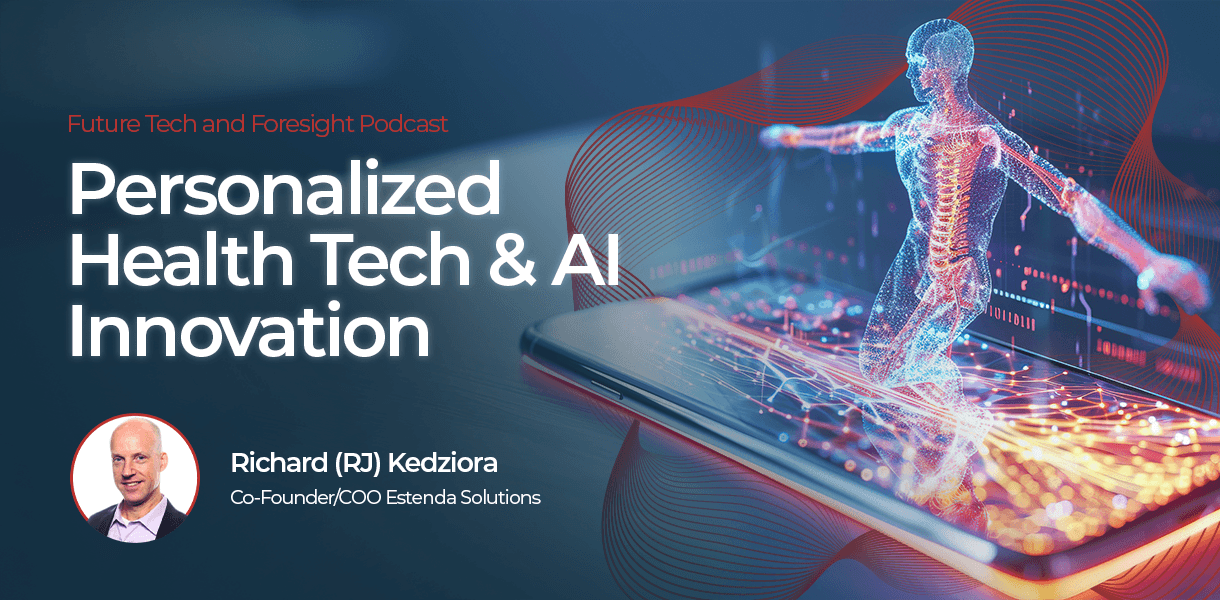
In a recent episode of the Future Tech and Foresight Podcast (Episode 214), our very own COO and co-founder, RJ, sat down with Marc Verbenkov to discuss how this shift in healthcare is already taking shape. His insights come from real experience building and scaling health technology, not speculation. What stood out most was how practical and human this change really is.
This isn’t about replacing doctors. It’s about giving you better tools to understand your body, make smarter daily choices, and detect issues earlier.
Wearables Are Turning Everyday Behavior Into Actionable Health Signals
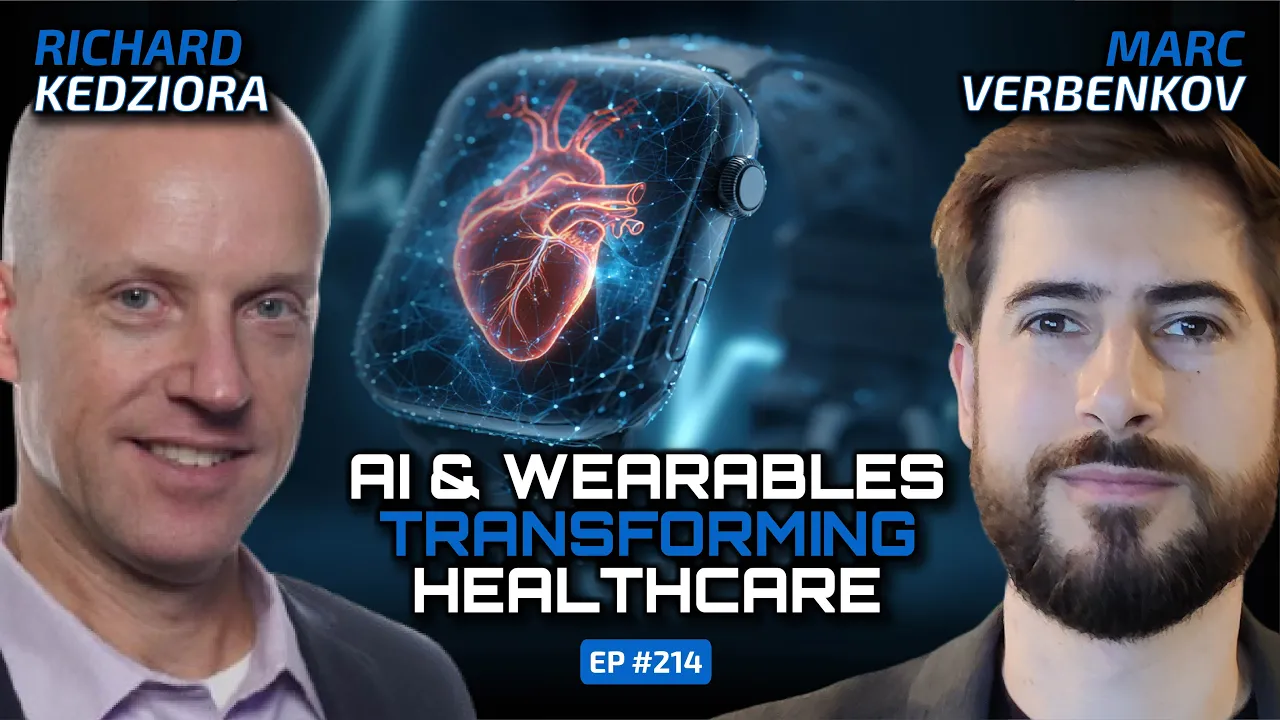
Wearables now quietly track your health in the background and turn daily behavior into clear, usable signals.
This matters because prevention starts with awareness. If you cannot see what is happening inside your body, you cannot change it. Wearables remove that blind spot.
Today’s devices track sleep, movement, heart rate, heart rate variability, and in some cases glucose levels. You do not have to log everything manually. You just live your life, and the data accumulates.
What makes this powerful for preventive healthcare is not the technology itself. It is how quickly you can connect cause and effect. You eat. You move. You rest. You immediately see how your body responds.
That feedback loop helps you make better decisions without needing medical training.
RJ explained how this shift happened when the tech finally stopped getting in the way.
“The technology is fading into the background, which is the sort of the first big hurdle. It’s, you know, how do you track your heart rate, heart rate variability, your sleep, how do you track all of this information. I think that’s very much a solved problem. We know how to do that.”
Once tracking becomes effortless, behavior change becomes realistic.
The real value shows up when you test small changes.
RJ further elaborated with a simple example that anyone can replicate.
“I’ll eat a meal and then go sit on the couch. The next night, I’ll eat the same meal and then go for a 10-minute walk afterwards. And you can see the difference that a simple walk makes. I’m not running. I’m not doing anything crazy. Going for a walk around the block.”
That is preventive healthcare in action.
No clinic visit required, no waiting rooms, no rushed appointments.
You can track your health, understand your body, and take meaningful steps every day to improve your wellness.
As RJ explained on the podcast, “It’s a powerful moment when you see how the numbers actually play out.” That simple insight, seeing the impact of small changes in real time, can transform the way you approach your health. Even something as easy as a ten-minute walk after a meal can make a measurable difference in how your body processes food. Personalized health tech turns everyday actions into data-driven opportunities for better health.
More: Can Artificial Intelligence Fix Our Broken Healthcare System?
AI Is Making Health Insights Truly Personal, Not Population-Based
AI makes health insights personal by focusing on your patterns, not averages. Traditional healthcare often relies on population-level guidance. Eat this. Avoid that. Exercise more. Sleep better. While well-meaning, this advice misses a crucial point: people respond differently to the same inputs.
AI changes that by analyzing your own data over time. Instead of comparing you to everyone else, it tracks how your body reacts to food, stress, movement, and sleep. It uncovers patterns no human could spot manually. RJ highlighted this difference clearly:
“There’s a lot of good information at a population level, but where we need to take this is that individual, based on what’s happening to me as an individual, my patterns and trends are sort of that next leap.”
This is where personalized health tech becomes essential for preventive care. The sooner you understand your own trends, the sooner you can take action and make adjustments that truly work for you.
AI also addresses a major gap in healthcare delivery. RJ explained, “People can’t do it at scale. There’s not enough medical professionals or not enough people to provide the care, the advice, the coaching to be able to do that.”
AI is not a replacement for clinicians. It supports you between visits, helping you make sense of your own data and take informed steps. “That’s where the AI really helps, starts changing that conversation. It enables me as an individual to better understand and use that data today,” RJ said.
The outcome is clarity and control. “There is no one-size-fits-all. Different people have to take different approaches.” Personalized health tech turns raw data into actionable insights, giving you a real edge in managing your health before problems even arise.
Preventive Healthcare Is Shifting Accountability From Clinics to Individuals
Preventive healthcare works best when you are engaged every day, not just during occasional checkups. Most health outcomes are shaped outside the doctor’s office—by what you eat, how often you move, how well you sleep, and how you manage stress.
RJ was blunt about the limits of the current system. “We really have a sick-based system in the world in healthcare. We call it healthcare, but it’s really sick care.”
Time is a constant constraint. “If you go to your doctor, you’re lucky if you get 10 minutes during that visit, and then they have to go on to the next patient.” That reality does not mean clinicians do not care. It means prevention has to happen elsewhere—daily, with the right guidance and tools.
“So much of what happens to all of our health outside of that doctor’s office and that doctor’s visit. What do you eat? What do you do from a movement perspective? What does your sleep look like?” RJ emphasized.
This is where personalized health tech makes a difference. It gives you visibility into those daily behaviors and trends, turning data into actionable insights. “I think of it as personal accountability for my health because so much of what happens to all of our health outside of that doctor’s office,” RJ said.
The shift is empowering. You gain agency over your own health without replacing professional support. Personalized health tools help you make smarter choices, understand your unique patterns, and act before small issues turn into serious problems. It’s about daily involvement, informed decisions, and real impact—long before you ever walk into a clinic.
AI Is Unlocking Early Disease Detection Through Non Traditional Signals
AI enables early detection by spotting subtle changes that humans often miss.
Some health signals are not obvious. Changes in smell, speech, movement, or daily routines can indicate early issues long before symptoms appear.
RJ discussed how overlooked signals are gaining attention.
“The loss of smell could be an indicator of health conditions, but until everybody started losing their sense of smell with COVID, it really didn’t get its due.”
Research now links sensory changes to neurological health.
“They are seeing that smell could be an indicator of Alzheimer’s, of Parkinson’s, of concussions, issues with the brain when you lose your sense of smell.”
At Estenda, we prioritize early detection and actionable health insights. Emerging research in health technology is revealing subtle signals that often go unnoticed. For instance, February 27 marks Anosmia Awareness Day, highlighting how shifts in the sense of smell can reflect broader health conditions.
In partnership with the Monell Chemical Senses Center and Ahersla Health, we are developing Hub4Smell, a specialized repository of smell test data. By leveraging AI to uncover new patterns, we aim to deepen understanding of how changes in smell connect to overall health. This initiative not only advances research on early warning signs but also brings chemosensory data into the spotlight, empowering the scientific and healthcare communities to better understand sensory health. Smell is a vital sign, and it deserves closer attention for what it can reveal.
Ready to Explore Personalized Health Tech With Estenda?
At Estenda, we partner with MedTech, Life Sciences, and Digital Health organizations to research, design, and build healthcare technology solutions. We provide strategy and planning, custom software development, AI and machine learning services, and data analytics, followed by hands-on implementation and ongoing support. Every solution is grounded in deep healthcare and medical research and built to solve real clinical, operational, and regulatory challenges. Our focus is on delivering technology that creates measurable impact for patients, clinicians, and healthcare organizations.
With over 23 years of experience, hundreds of successful projects, and dozens of peer-reviewed publications, Estenda transforms ideas into evidence-based, real-world solutions. From leveraging wearables and AI to advancing preventive healthcare, we turn complex data into actionable insights that improve outcomes and support healthier communities.
Take the next step in personalized health tech. Contact us today at info@estenda.com to schedule your consultation and start translating your AI and healthcare strategy into tangible results.